
Skincare Treatment: A Complete Guide to Healthier, Clearer, and More Balanced Skin
August 28, 2026
Does Hyaluronic Acid Eye Cream Reduce Fine Lines?
August 29, 2026
Finding good face products for sensitive skin can be harder than it sounds. A product may look gentle on the label but still cause burning, redness, dryness, itching, or small bumps. Sensitive skin can also react differently from one person to another, so there is no single product that works perfectly for everyone.
The good news is that sensitive skin usually does not need a complicated routine. In fact, using fewer products can often make skincare easier to manage. Dermatologists commonly recommend focusing on a gentle cleanser, a fragrance-free moisturizer, and daily broad-spectrum sunscreen.
This guide explains how to choose good face products for sensitive skin, which ingredients are usually helpful, which ingredients may cause problems, how to build a simple routine, and how to test new products before applying them to your entire face.
What Is Sensitive Skin?
Sensitive skin is a common term used when the skin reacts easily to products, weather, friction, or other environmental factors. A person with sensitive skin may experience stinging, burning, redness, itching, tightness, dryness, or irritation after using a skincare product.
Sensitive skin is not necessarily the same as a skin disease. However, conditions such as eczema, rosacea, contact dermatitis, and acne can make the skin more reactive.
One important point is that sensitive skin does not always look dry. Someone can have oily, combination, normal, or dry skin and still have sensitivity.
For example, a person may have oily skin but experience burning after using a strong exfoliating acid. Another person may have dry skin that becomes red after using a fragranced moisturizer.
This is why choosing products based only on whether they are labeled for “dry skin” or “oily skin” is not enough. You also need to consider how easily your skin becomes irritated.
What Makes Good Face Products for Sensitive Skin?
The best face products for sensitive skin usually have a simple purpose and a relatively gentle formula.
Instead of looking for a product with dozens of active ingredients, start by asking a few basic questions:
- Is it fragrance-free?
- Is it gentle enough for regular use?
- Does it contain ingredients that support the skin barrier?
- Is it appropriate for your skin type?
- Does it have a texture you can comfortably use every day?
- Can you introduce it slowly?
- Does the product cause burning, itching, or unusual redness?
A simple formula is not automatically better, but sensitive skin often benefits from avoiding unnecessary sources of irritation.
The American Academy of Dermatology recommends fragrance-free products for sensitive and dry skin. It also points out that “unscented” does not necessarily mean fragrance-free because an unscented product can contain ingredients used to mask odors.
Best Face Products for Sensitive Skin at a Glance
A basic sensitive-skin routine can include the following:
| Product type | What to look for |
| Facial cleanser | Gentle, fragrance-free, non-abrasive |
| Moisturizer | Fragrance-free, barrier-supporting ingredients |
| Sunscreen | Broad-spectrum SPF 30 or higher |
| Makeup remover | Gentle, fragrance-free formula |
| Lip product | Simple moisturizing ingredients |
| Treatment product | Introduce slowly and only when needed |
| Exfoliant | Mild formula, used sparingly or avoided during irritation |
The goal is not to use every category listed above. Most people can start with just three core products: cleanser, moisturizer, and sunscreen.
Best Facial Cleansers for Sensitive Skin
A facial cleanser is one of the most important products in a sensitive-skin routine because it is used frequently.
The wrong cleanser can leave your face feeling tight, dry, rough, or uncomfortable. That feeling is not necessarily proof that the cleanser has “worked.” For sensitive skin, excessive cleansing can remove oils that help protect the skin barrier.
Look for a cleanser that removes sweat, dirt, sunscreen, and makeup without leaving your skin feeling stripped.
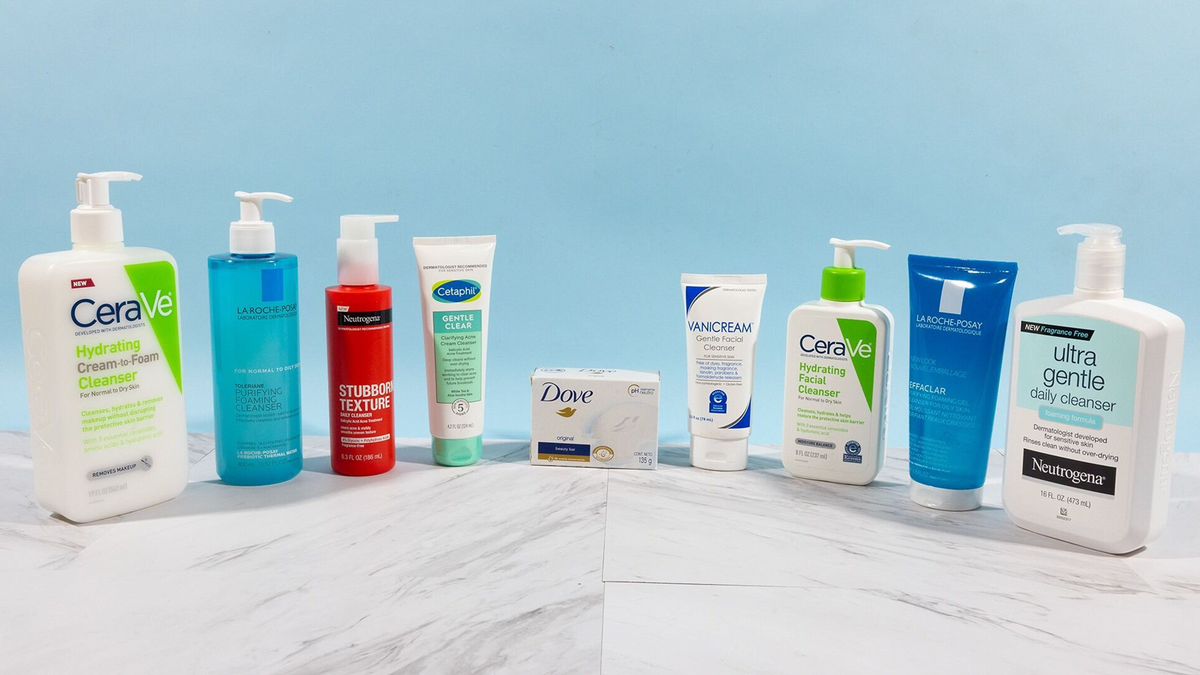
A fragrance-free, gentle cleanser is generally a good starting point. Some sensitive-skin cleansers contain ingredients such as glycerin, panthenol, niacinamide, or mild cleansing agents. For example, the National Eczema Association lists a fragrance-free Cetaphil facial cleanser containing glycerin, niacinamide, and panthenol among products accepted for sensitive or eczema-prone skin.
That does not mean every person with sensitive skin will tolerate that exact product. Individual reactions still matter.
Cream Cleansers
Cream cleansers can be useful for people with dry or easily irritated skin.
They usually feel more moisturizing than traditional foaming cleansers. If your skin feels tight after washing, a cream or lotion-style cleanser may be worth considering.
Gel Cleansers
A gentle gel cleanser may work well for combination or oily sensitive skin.
The key is not simply whether the cleanser is a gel. The formula matters more than the texture. A gentle gel cleanser can be perfectly suitable for sensitive skin if it cleans effectively without causing irritation.
Foaming Cleansers
Foaming cleansers are not automatically bad for sensitive skin.
However, some strongly cleansing formulas may feel drying, especially if you already have a damaged skin barrier. If your face feels tight immediately after cleansing, consider switching to a gentler formula.
How Often Should You Wash Sensitive Skin?
There is no universal rule that every person must wash their face twice a day.
People with oily or acne-prone skin may prefer morning and evening cleansing. Someone with very dry or sensitive skin may find that cleansing once in the evening is enough, especially if the face is not dirty or sweaty in the morning. The AAD notes that people with dry or sensitive skin may need only one wash per day in the evening.
Use lukewarm rather than very hot water and avoid aggressive rubbing.
After cleansing, gently pat the face dry instead of scrubbing it with a towel.
Best Moisturizers for Sensitive Skin
A good moisturizer is one of the most useful face products for sensitive skin.
Moisturizers help reduce water loss and support the skin barrier. When the barrier is weakened, the skin can become more vulnerable to irritation.
For sensitive skin, look for a moisturizer that is:
- Fragrance-free
- Gentle
- Suitable for your skin type
- Easy to use consistently
- Rich enough to prevent dryness without feeling uncomfortable
Creams and ointments are often more protective than lightweight lotions, especially when the skin is very dry. The AAD recommends fragrance-free creams or ointments rather than lotions for people dealing with very dry or eczema-prone skin.
Ingredients to Look for in Sensitive-Skin Moisturizers
Certain ingredients can be especially useful when the goal is hydration and barrier support.
Glycerin
Glycerin is a humectant. It helps attract water and is commonly used in moisturizers.
It is widely used because it can provide hydration without needing a complicated formula.
Ceramides
Ceramides are lipids naturally found in the skin barrier. Moisturizers containing ceramides can help support the barrier and reduce moisture loss.
They are especially popular in products designed for dry and sensitive skin.
Hyaluronic Acid
Hyaluronic acid is another humectant that can help attract water.
Despite its popularity, it does not need to be the star ingredient in every moisturizer. A sensitive-skin moisturizer does not have to contain every trending ingredient to be effective.
Panthenol
Panthenol, also known as provitamin B5, is used in many moisturizing and soothing formulas.
It can be useful when you want hydration without a heavy product.
Petrolatum
Petrolatum is one of the most effective occlusive ingredients for reducing water loss from the skin.
It is simple, inexpensive, and highly useful for very dry areas. A small amount can be applied over moisturizer when extra protection is needed.
Dimethicone
Dimethicone is a silicone-based ingredient commonly used to create a smooth protective layer over the skin.
It can help reduce water loss and improve the feel of moisturizers.
Should Sensitive Skin Avoid All Oils?
Not necessarily.
The word “oil” does not automatically mean that a product will irritate sensitive skin. However, some essential oils and fragrant botanical oils can cause irritation or allergic reactions in certain people.
If your skin is highly reactive, a fragrance-free moisturizer with a simple ingredient list may be a safer starting point than a product packed with essential oils.
This is one reason why “natural” should not automatically be interpreted as “gentle.”
A natural ingredient can still irritate the skin.
The Best Sunscreen for Sensitive Skin
Daily sunscreen is an important part of skincare, including for people with sensitive skin.
The AAD recommends broad-spectrum, water-resistant sunscreen with SPF 30 or higher.
If sunscreen frequently stings or burns your face, mineral sunscreens containing zinc oxide and/or titanium dioxide may be worth trying. The AAD specifically recommends sunscreens containing zinc oxide or titanium dioxide for people whose skin stings or burns when sunscreen is applied.
Mineral Sunscreen
Mineral sunscreens use active ingredients such as zinc oxide and titanium dioxide.
They can be a useful choice for sensitive skin, especially when chemical sunscreen formulas cause stinging.
The downside is that some mineral sunscreens can leave a visible white cast, particularly on darker skin tones.
Tinted mineral sunscreens may help reduce this problem. The AAD notes that tinted sunscreen can help prevent a white residue on darker skin tones.
Chemical Sunscreen
Chemical sunscreens can work very well and are tolerated by many people.
Sensitive skin does not automatically mean that you must avoid every chemical sunscreen. However, if a particular sunscreen causes burning, redness, or itching, switching to a fragrance-free mineral formula may be reasonable.
The best sunscreen is ultimately one you can apply generously and consistently without discomfort.
What Does “Fragrance-Free” Really Mean?
“Fragrance-free” is one of the most useful terms to look for when choosing good face products for sensitive skin.
Fragrance ingredients can trigger irritation or allergic reactions in some people. The AAD recommends choosing products labeled fragrance-free rather than relying on “unscented.”
Unscented and fragrance-free are not identical terms.
An unscented product may still contain ingredients that mask the natural smell of the formula.
If your skin is easily irritated, fragrance-free is usually the clearer choice.
Ingredients That May Irritate Sensitive Skin
Sensitive skin does not mean you must permanently avoid a long list of ingredients.
Still, certain categories deserve caution, especially when your skin is already irritated.
These can include:
- Added fragrance
- Essential oils
- Strong exfoliating acids
- High-strength retinoids
- Strong alcohol-based formulas
- Rough physical scrubs
- Highly concentrated active ingredients
- Products with many unnecessary botanical extracts
The important point is that an ingredient is not automatically “bad” simply because it can irritate some people.
For example, retinoids can provide important benefits, but introducing a strong retinoid too quickly can cause dryness and irritation.
The same principle applies to exfoliating acids.
Sensitive skin usually benefits from a slower approach.
Why Essential Oils Can Be a Problem
Essential oils are popular in natural and luxury skincare products because they provide scent and are associated with plant-based ingredients.
However, “plant-based” does not mean irritation-free.
Some essential oils contain fragrance compounds that may irritate sensitive skin or contribute to allergic contact dermatitis.
If your skin frequently becomes red or itchy after skincare, a fragrance-free routine can make it easier to identify what your skin tolerates.
Are Alcohols Bad for Sensitive Skin?
This question is more complicated than it looks.
There are many different types of alcohol used in skincare.
Some alcohols can feel drying, while fatty alcohols such as cetyl alcohol and stearyl alcohol are commonly used to improve the texture and stability of creams and are not equivalent to drying alcohols.
Therefore, seeing the word “alcohol” on an ingredient list does not automatically mean that the product is unsuitable for sensitive skin.
Instead of judging a product from one ingredient alone, consider the entire formula and how your skin responds.
Do Sensitive Skin Products Need to Be “Natural”?
No.
There is no requirement for a sensitive-skin product to be natural.
A synthetic ingredient can be gentle, while a natural ingredient can cause irritation.
This is one of the most important ideas when shopping for sensitive skin products.
Rather than focusing on marketing words such as “natural,” “clean,” or “organic,” focus on practical characteristics such as fragrance-free formulation, gentle cleansing, hydration, and your personal tolerance.
What About “Hypoallergenic” Products?
The word “hypoallergenic” can be helpful, but it should not be treated as a guarantee that a product cannot cause a reaction.
People can react to many different ingredients.
A product marketed for sensitive skin may still not work for everyone.
This is why patch testing and gradual introduction are useful.
How to Patch Test a New Face Product
If your skin reacts easily, do not immediately cover your entire face with a new product.
Instead, test a small amount first.
Apply the product to a small area of skin, such as the inner arm or another discreet area. Watch the area for signs of irritation before expanding use.
The AAD recommends testing new skincare products before using them more broadly, particularly for people dealing with eczema or reactive skin.
A patch test cannot guarantee that your face will never react, but it can reduce the chance of discovering a problem after applying a new product everywhere.
A Simple Morning Routine for Sensitive Skin
A sensitive-skin morning routine does not need to contain six or eight products.
A simple routine can look like this:
Step 1: Gentle Cleansing
If your skin is oily or sweaty, use a gentle cleanser.
If your skin is very dry or sensitive, you may simply rinse with lukewarm water in the morning and cleanse at night.
Step 2: Moisturizer
Apply a fragrance-free moisturizer that fits your skin type.
If your face feels dry during the day, you may need a richer formula.
Step 3: Sunscreen
Finish with broad-spectrum SPF 30 or higher.
If sunscreen causes burning, consider a fragrance-free mineral sunscreen containing zinc oxide or titanium dioxide.
A Simple Night Routine for Sensitive Skin
Your evening routine can be equally simple.
Start by removing makeup and sunscreen with a gentle cleansing product.
Then apply moisturizer.
If you use a treatment product, introduce it slowly and avoid adding several new treatments at the same time.
This makes it much easier to identify which product is helping and which one may be causing irritation.
Sensitive Skin and Acne
Having sensitive skin does not mean you cannot have acne.
In fact, people with acne may accidentally irritate their skin by using too many acne products.
Scrubbing harder, washing repeatedly, or combining several strong acne treatments can make the skin uncomfortable.
A better approach is to begin with a gentle cleanser and moisturizer, then introduce an acne treatment gradually.
Look for non-comedogenic products if you are concerned about clogged pores. The AAD recommends looking for “non-comedogenic” or “won’t clog pores” labeling for oily skin.
Sensitive Skin and Dryness
If your skin feels tight immediately after washing, your routine may be too aggressive.
Consider switching to:
- A gentler cleanser
- A thicker moisturizer
- Lukewarm water
- Less frequent cleansing
- Fewer active treatments
Apply moisturizer while the skin is slightly damp. Moisturizing after washing can help retain hydration.
Sensitive Skin and Redness
Redness can have many causes.
It may come from irritation, dryness, sun exposure, allergies, rosacea, eczema, or another condition.
If redness is persistent, painful, itchy, or worsening, skincare alone may not solve the problem.
Instead of repeatedly buying new products, consider talking with a dermatologist.
A medical diagnosis can be especially helpful when the skin does not improve after simplifying your routine.
Should You Exfoliate Sensitive Skin?
Exfoliation is not mandatory.
This is an important point that is often missed in skincare discussions.
You do not need to exfoliate simply because a skincare routine says you should.
If your skin is sensitive, irritated, dry, or peeling, adding an exfoliating product may make the situation worse.
Physical scrubs can be particularly uncomfortable because rubbing already-irritated skin creates additional mechanical stress.
If you want to use a chemical exfoliant, start slowly and choose a mild formula. Do not introduce it while your skin is actively irritated.
Should Sensitive Skin Use Retinol?
Sensitive skin can sometimes tolerate retinoids, but they should be introduced carefully.
Retinoids may cause dryness, peeling, redness, and irritation, particularly during the early stages.
If you want to use retinol, start with a low-strength product and use it infrequently. Follow with moisturizer and give your skin time to adjust.
If you have eczema, rosacea, severe sensitivity, or persistent irritation, discuss retinoid use with a dermatologist before starting.
The Importance of a Healthy Skin Barrier
The skin barrier is one of the most important concepts for people with sensitive skin.
Think of the skin barrier as a protective outer layer. It helps keep water inside the skin while helping protect against outside irritants.
When the barrier becomes damaged, the skin may feel:
- Tight
- Dry
- Rough
- Itchy
- Red
- More sensitive than usual
This creates a cycle where people often add more products to fix the problem, which can sometimes create even more irritation.
A better strategy is often to simplify.
Gentle cleansing, regular moisturizing, and sun protection form a strong foundation for sensitive skin. The National Eczema Association also emphasizes gentle cleansing and regular fragrance-free moisturizing for sensitive and eczema-prone skin.
How Many Products Does Sensitive Skin Really Need?
Usually, fewer than you think.
A basic routine can contain:
- Gentle cleanser
- Fragrance-free moisturizer
- Broad-spectrum sunscreen
Everything else is optional.
You can add treatments based on a specific goal, such as acne, dark spots, or signs of aging.
The benefit of starting small is that you can understand how your skin responds.
If you begin five new products on the same day and your face becomes irritated, you will not know which product caused the problem.
How to Choose Good Face Products for Sensitive Skin
When shopping for good face products for sensitive skin, do not rely only on the front of the package.
Turn the package around and read the ingredient list.
Look for fragrance-free products and consider formulas with moisturizing ingredients such as glycerin, ceramides, panthenol, petrolatum, or dimethicone.
For sunscreen, look for broad-spectrum SPF 30 or higher.
If your skin burns when sunscreen is applied, consider zinc oxide or titanium dioxide.
Most importantly, buy fewer products at first.
A simple routine that you use consistently is often more useful than an expensive collection of products that constantly changes.
What to Avoid When Your Skin Is Irritated
When your face is actively irritated, consider temporarily removing unnecessary products.
This can include:
- Scrubs
- Strong acids
- Retinoids
- Fragranced products
- Essential oils
- Strong masks
- Multiple acne treatments
- New cosmetic products
Return to the basics: gentle cleansing, moisturizer, and sunscreen.
Once the skin feels comfortable again, products can be reintroduced one at a time.
How Weather Can Affect Sensitive Skin
Sensitive skin can react to changes in the environment. Cold, dry weather can increase dryness, while hot weather can increase sweating and discomfort. Wind can also make already-dry skin feel worse. Indoor heating and air conditioning may further reduce humidity.
During cold winter months, focus on protecting the skin barrier. Use lukewarm water instead of hot water, choose a gentle cleanser, and apply a richer fragrance-free moisturizer when your skin feels dry. A lip balm can also help protect dry lips. If your skin becomes extremely dry, a thin layer of petrolatum over moisturizer at night may help reduce moisture loss.
During hot summer months, keep your routine simple and focus on sun protection, hydration, and gentle cleansing. Choose a comfortable broad-spectrum sunscreen and reapply it as needed when spending time outdoors. If you sweat heavily, a water-resistant sunscreen can be useful. Avoid using harsh cleansers simply because your skin feels oily during hot weather. Sweat and oil can be removed gently without stripping the skin.
Your skincare routine does not have to remain exactly the same throughout the year. Adjusting the moisturizer, cleanser, and sunscreen according to the weather and how your skin feels can make a sensitive-skin routine more comfortable and easier to maintain.
Makeup for Sensitive Skin
Sensitive skin does not mean you must stop wearing makeup.
However, choose makeup carefully.
Look for products that are fragrance-free when possible and avoid using old products.
Clean makeup brushes regularly.
Remove makeup gently at night instead of scrubbing.
If a foundation repeatedly causes burning or itching, stop using it and test another formula.
Face Products for Sensitive Skin and Aging
People with sensitive skin may still want to address wrinkles, uneven tone, or loss of firmness.
The key is not to attack every concern at once.
Start with sunscreen and moisturizer.
Sun protection is one of the most important long-term steps for maintaining healthier-looking skin. The AAD recommends broad-spectrum SPF 30 or higher along with shade and protective clothing.
Once your basic routine is stable, you can consider adding one anti-aging active at a time.
A Better Way to Think About “Good” Skincare
A good product is not necessarily the product with the longest ingredient list.
For sensitive skin, a good product is one that performs its job without creating a new problem.
A cleanser should clean without excessive dryness.
A moisturizer should hydrate without causing irritation or unwanted breakouts.
A sunscreen should protect from UV exposure without making you avoid sunscreen because it burns.
A treatment should address a specific concern without overwhelming your skin.
This way of thinking is more useful than chasing every new skincare trend.
Common Mistakes People Make With Sensitive Skin
One common mistake is changing products too often.
Another is assuming that burning means a product is working.
It does not.
A strong tingling sensation is not proof that a skincare ingredient is effective.
Another mistake is using too many active ingredients at once.
For example, someone may use an exfoliating acid, retinol, acne treatment, vitamin C product, and exfoliating cleanser in the same routine. Even if each product is individually useful, the combined routine may be too irritating.
Sensitive skin usually rewards patience.
When You Should See a Dermatologist
Not every skin problem should be managed with skincare products.
Consider seeing a dermatologist if you have:
- Persistent redness
- Severe itching
- Repeated swelling
- Painful skin
- Cracking or bleeding
- A rash that does not improve
- Frequent reactions to many products
- Severe acne
- Symptoms around the eyes
- Symptoms that interfere with sleep or daily activities
A dermatologist can determine whether the problem is simple sensitivity or something such as eczema, rosacea, allergic contact dermatitis, or another skin condition.
Final Thoughts
The best approach to finding good face products for sensitive skin is to keep things simple, gentle, and consistent. Start with a mild cleanser, a fragrance-free moisturizer, and a broad-spectrum SPF 30 or higher sunscreen. Choose products based on their ingredients and how your skin responds rather than relying only on marketing claims. If your skin is easily irritated, introduce one new product at a time and give your skin an opportunity to adjust. Sensitive skin does not need to be treated with fear, but it does benefit from patience and careful product selection. When irritation is persistent or severe, professional dermatology advice is more useful than continually changing skincare products.
FAQs About Good Face Products for Sensitive Skin
1. Can sensitive skin use vitamin C?
Yes, but some vitamin C products can cause stinging or irritation. If you want to try vitamin C, start with a gentle formula and introduce it slowly. Stop using it if you develop persistent burning, redness, or itching.
2. Is micellar water good for sensitive skin?
Micellar water can be useful for removing makeup or sunscreen, but formulas vary. Choose a fragrance-free option and avoid rubbing the skin. If it leaves your face feeling dry or irritated, use a gentle facial cleanser instead.
3. Can sensitive skin use face masks?
Sensitive skin can sometimes tolerate gentle hydrating masks, but strong clay masks, peel-off masks, and exfoliating masks may cause irritation. Avoid masks when your skin is already red, burning, or damaged.
4. Is aloe vera always safe for sensitive skin?
No ingredient is guaranteed to work for every person. Aloe can feel soothing for some people, but botanical ingredients can still cause irritation or allergy in others. Patch testing is a smart approach when trying a new aloe-based product.
5. Should I stop skincare completely when my face becomes irritated?
You usually do not need to stop all skincare. Instead, simplify your routine. A gentle cleanser, bland fragrance-free moisturizer, and appropriate sunscreen can provide a basic foundation. If irritation is severe, persistent, or worsening, consult a dermatologist rather than trying more products.