
Good Face Products for Sensitive Skin: A Simple Guide to Choosing Gentle, Effective Skincare
August 28, 2026
Best Face Wash Cleanser for Oily Skin: A Complete Guide for Clearer, Healthier-Looking Skin
August 29, 2026
Hyaluronic acid eye cream has become a popular part of modern skincare routines, especially for people who want the skin around their eyes to look smoother, softer, and more hydrated. The eye area is often one of the first places where dryness and fine lines become noticeable. Because the skin around the eyes is relatively thin and can lose moisture easily, hydration is an important part of basic eye-area skincare.
But what does hyaluronic acid actually do? Is an eye cream with hyaluronic acid better than a regular moisturizer? Can it reduce dark circles or puffiness? How should you apply it, and what ingredients should you look for?
This guide answers those questions in simple terms. It explains how hyaluronic acid works, what you can reasonably expect from a hyaluronic acid eye cream, how to use it safely, and how to choose a product based on your skin needs.
The goal is not to suggest that one product works for everyone. Instead, this article provides practical, evidence-informed information to help U.S. consumers understand their options and make better skincare decisions.
What Is Hyaluronic Acid Eye Cream?
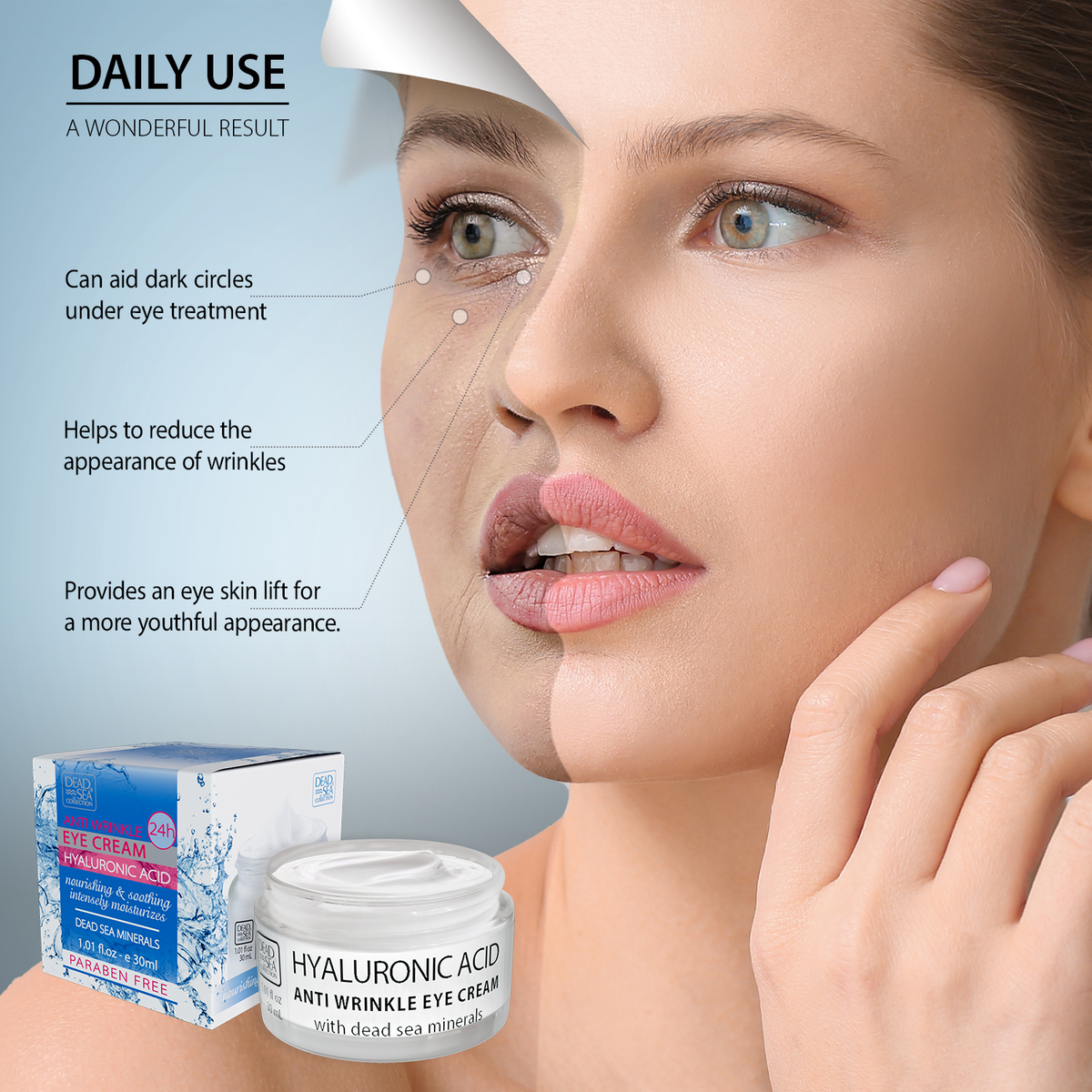
Hyaluronic acid eye cream is a skincare product designed for the delicate skin around the eyes and formulated with hyaluronic acid as one of its moisturizing ingredients.
Hyaluronic acid is a substance naturally found in the human body. It helps hold water in tissues and contributes to skin hydration. In skincare products, it is commonly used as a humectant. A humectant helps attract and retain water near the skin’s surface.
An eye cream containing hyaluronic acid may therefore help the skin around the eyes feel more hydrated and appear temporarily smoother.
The term “eye cream” does not mean that the product goes inside the eyes. These products are intended for the external skin surrounding the eyes. Applying skincare directly into the eye can cause irritation and should generally be avoided unless the product is specifically made for ocular use.
What Does Hyaluronic Acid Do for the Skin Around the Eyes?
The main role of hyaluronic acid in skincare is hydration.
When the outer layers of skin contain enough water, the skin can appear softer and more supple. Dehydrated skin may look rough, tight, or more lined. Adding moisture can make fine lines caused partly by dryness look less noticeable.
Hyaluronic acid can support this process by helping attract water to the skin.
For the eye area, this can be useful because the skin around the eyes can become dry from factors such as:
- Cold or dry weather
- Indoor heating
- Air conditioning
- Frequent washing
- Some skincare products
- Environmental exposure
- Natural changes in skin moisture with age
A hyaluronic acid eye cream may help improve the feeling and appearance of dryness, but it is important to understand its limits. Hydration does not permanently remove wrinkles, change facial anatomy, or eliminate every cause of dark circles.
What Are the Main Benefits of Hyaluronic Acid Eye Cream?
The benefits of a hyaluronic acid eye cream mainly relate to moisture and the appearance of the skin.
1. It Helps Hydrate Dry Skin
The most direct benefit is increased skin hydration.
An eye cream with hyaluronic acid can help the skin feel less dry and tight. This may be particularly useful during winter or in environments with low humidity.
2. It Can Make Fine Lines Look Softer
Dehydrated skin can make small lines look more visible. By increasing surface hydration, hyaluronic acid may temporarily make the skin appear smoother.
This does not mean that hyaluronic acid repairs every type of wrinkle. It is better understood as a hydration-focused ingredient that can improve the appearance of dryness-related lines.
3. It Can Improve Skin Texture
Well-hydrated skin often feels softer and smoother.
Using a suitable eye cream consistently may help improve the overall feel of the under-eye area, especially when dryness is the main concern.
4. It Can Support a Healthy-Looking Skin Barrier
A properly moisturized skin barrier helps reduce excessive water loss from the skin.
Hyaluronic acid is not the only ingredient involved in skin-barrier support. Other ingredients, such as ceramides and certain emollients, can also be important.
For this reason, a good eye cream may contain several complementary ingredients rather than relying on hyaluronic acid alone.
5. It Can Make the Eye Area Look More Refreshed
Dry skin can look dull or tired. Hydration may give the area a temporarily smoother and healthier appearance.
This is one reason an eye cream hyaluronic acid formula can be appealing to people who want a simple hydration step in their morning or evening routine.
Can Hyaluronic Acid Eye Cream Reduce Dark Circles?
Not necessarily.
Dark circles have many possible causes, and hydration is only one part of the picture.
Under-eye darkness can be related to:
- Genetics
- Natural skin pigmentation
- Sun exposure
- Visible blood vessels
- Shadows caused by facial structure
- Thinner skin
- Aging
- Allergies or rubbing
- Lack of sleep or temporary fatigue
A hyaluronic acid under eye cream can moisturize the skin and may make the area look smoother. However, hyaluronic acid itself is not generally considered a primary treatment for every type of dark circle.
If pigmentation is the main issue, ingredients designed for brightening may be more relevant. If shadows are caused by facial structure, a topical moisturizer may have limited effects.
This distinction is important because skincare marketing can sometimes make a moisturizing ingredient sound capable of solving several unrelated problems.
Does Hyaluronic Acid Eye Cream Help With Puffy Eyes?
It depends on why the eyes look puffy.
Temporary puffiness can occur because of sleep changes, fluid retention, allergies, crying, diet, or other everyday factors. Aging and facial anatomy can also influence the appearance of bags beneath the eyes.
Hyaluronic acid primarily provides hydration. It is not a universal anti-puffiness ingredient.
If puffiness is persistent, severe, occurs mainly on one side, or is associated with pain, redness, vision changes, or other unusual symptoms, it is better to speak with a healthcare professional rather than relying on cosmetic skincare.
Is Hyaluronic Acid Safe for the Eye Area?
Hyaluronic acid is widely used in skincare products and is generally considered a well-tolerated moisturizing ingredient for many people.
However, the safety of a finished eye cream depends on the entire formula, not just one ingredient.
The eye area is sensitive, and some people may react to:
- Fragrance
- Essential oils
- Preservatives
- Retinoids
- Acids
- Botanical ingredients
- Certain active ingredients
A product can therefore be well formulated and still cause irritation for a particular person.
Always follow the product’s directions. Keep cosmetic products out of the eye itself unless they are specifically designed for use inside the eye.
How to Use Hyaluronic Acid Eye Cream Correctly
Using an eye cream is usually simple.
Step 1: Clean Your Face
Start with clean skin. Use a gentle cleanser that does not leave your skin feeling excessively dry or tight.
Step 2: Apply Your Other Lightweight Products
If you use a hydrating serum, you may apply it according to the instructions for that product.
There is no universal rule that says eye cream must always go before or after every other skincare product. Product texture and instructions matter.
Step 3: Apply a Small Amount of Eye Cream
You usually need only a small amount for both eyes.
Apply the product to the skin around the eye rather than directly into the eye.
Step 4: Use Gentle Touch
The skin around the eyes is delicate. Avoid aggressive rubbing or pulling.
A light application with a fingertip is generally enough.
Step 5: Finish With Moisturizer and Sunscreen
If your routine includes a face moisturizer, use it as appropriate.
During the daytime, sunscreen is especially important. Sun protection helps reduce cumulative UV damage, which can contribute to premature skin aging and uneven pigmentation.
When Should You Apply Hyaluronic Acid Eye Cream?
Many people use a hyaluronic acid eye cream once or twice daily, depending on the product instructions and their personal routine.
Morning use can help hydrate the skin before makeup.
Evening use can provide another moisturizing step before sleep.
Consistency is usually more important than applying a large amount. Using more product does not necessarily produce better results.
If you are trying a new product, start according to the label directions and observe how your skin responds.
Can You Use Hyaluronic Acid Eye Cream Every Day?
For many people, yes.
Hyaluronic acid is primarily a moisturizing ingredient, and products containing it are commonly designed for regular use.
However, the complete formula matters. An eye cream may contain additional ingredients that are more active or potentially irritating.
Read the product directions carefully. If you experience persistent burning, swelling, significant redness, rash, or other concerning symptoms, stop using the product and consider seeking medical advice.
Hyaluronic Acid Eye Cream vs. Face Moisturizer
A common question is whether a separate eye cream is necessary.
The answer depends on the product and your personal skincare goals.
A basic face moisturizer may provide enough hydration for some people. However, an eye cream may have a lighter texture or may contain ingredients specifically selected for the appearance of the eye area.
There is no universal scientific rule that every person must own a separate eye cream.
For someone primarily concerned about dryness, a gentle moisturizer may be sufficient. Someone looking for a dedicated product for the eye area may prefer an eye cream with hyaluronic acid.
The important point is to compare formulas rather than assume that a higher price or a smaller package automatically means better performance.
What Ingredients Work Well With Hyaluronic Acid?
Hyaluronic acid can be combined with many other skincare ingredients.
Ceramides
Ceramides are lipids naturally found in the skin barrier. They are commonly used in moisturizers designed to support skin hydration and barrier function.
A formula containing both hyaluronic acid and ceramides may provide a broader moisturizing approach.
Glycerin
Glycerin is another common humectant. It helps attract and retain water in the skin.
A product containing glycerin and hyaluronic acid can provide multiple moisturizing mechanisms.
Peptides
Peptides are short chains of amino acids used in many cosmetic formulations. Some skincare products include peptides as part of an anti-aging-focused formula.
Evidence varies by specific peptide and product, so consumers should avoid assuming that every peptide product produces the same results.
Caffeine
Caffeine is frequently included in eye products marketed for a more awake-looking eye area.
It may be used in formulas designed to address the appearance of puffiness or tired-looking skin, although the effect depends on the formulation and individual factors.
Niacinamide
Niacinamide, also called vitamin B3, is used in skincare for several purposes, including supporting the skin barrier and improving the appearance of uneven skin tone.
Some people tolerate it very well, while others may experience irritation depending on the concentration and formula.
Antioxidants
Some eye creams contain antioxidants such as vitamin C derivatives, vitamin E, or other antioxidant compounds.
These ingredients are often included in products designed to help protect or improve the appearance of skin affected by environmental stress.
What Ingredients Should You Be Careful With Around the Eyes?
The eye area can be more sensitive than other parts of the face.
Some ingredients may cause irritation, especially when used too frequently or at high concentrations.
These can include:
- Retinoids
- Exfoliating acids
- Fragrance
- Essential oils
- Strong active ingredients
- Certain preservatives
This does not mean every one of these ingredients is automatically unsafe. Some can be used around the eyes in carefully formulated products.
The important factor is whether the product is specifically designed for the eye area and whether your skin tolerates it.
How to Choose the Best Hyaluronic Acid Eye Cream
There is no single best hyaluronic acid eye cream for everyone.
Instead, consider your primary skincare goal.
If Your Main Concern Is Dryness
Look for a moisturizing formula containing hyaluronic acid along with ingredients such as glycerin, ceramides, or other skin-conditioning ingredients.
If You Have Sensitive Skin
A fragrance-free formula may be worth considering.
Keep the ingredient list simple if you know that your skin reacts easily to certain ingredients.
If You Want to Address Fine Lines
Look for a hydrating formula and consider products that contain additional ingredients supported for cosmetic anti-aging purposes.
Remember that sunscreen remains one of the most important daily steps for protecting skin from UV-related premature aging.
If Your Concern Is Dark Circles
First try to understand what type of dark circle you have.
A moisturizing product may improve the look of dry, crepey skin but may not significantly change genetic pigmentation or structural shadows.
If You Have Puffy Eyes
Consider whether the puffiness is temporary or persistent.
A cosmetic eye cream may improve the overall appearance of the area, but persistent swelling may require a different approach.
Is an Expensive Eye Cream Better?
Not automatically.
Price does not guarantee that a product will work better for your skin.
An inexpensive eye cream with a well-designed formula may provide excellent hydration. A luxury product may offer a different texture, packaging, sensory experience, or combination of ingredients.
When comparing products, look beyond marketing language.
Consider:
- Ingredients
- Skin type
- Fragrance
- Product texture
- Packaging
- Usage instructions
- Personal tolerance
- Value for the amount of product
A higher price is not proof of greater effectiveness.
What About AHAVA Hyaluronic Acid Eye Cream?
AHAVA is a skincare brand known for products associated with Dead Sea minerals and skin-care formulations.
Searches for “ahava hyaluronic acid eye cream” may refer to specific AHAVA eye-area products that contain hyaluronic acid or other moisturizing and skin-conditioning ingredients.
If you are considering a particular AHAVA product, check the current packaging and ingredient list because cosmetic formulas, names, sizes, and availability can change over time.
It is also useful to compare the product with other eye creams rather than choosing it solely because of the brand name.
Look at what the formula is designed to do, which ingredients it contains, and whether those features match your skincare goals.
Common Mistakes When Using Eye Cream
Even a well-formulated eye cream may be disappointing if it is used incorrectly.
Applying Too Much
More product does not necessarily mean more hydration.
A small amount is usually enough for the eye area.
Rubbing the Skin
Aggressive rubbing can irritate sensitive skin.
Use gentle movements.
Putting the Product Too Close to the Eye
Cosmetic eye creams are normally intended for the skin surrounding the eye, not the eyeball.
Follow the manufacturer’s directions.
Skipping Sunscreen
Hydration is useful, but it does not replace sun protection.
Daily broad-spectrum sunscreen is an important part of a complete skincare routine.
Expecting Immediate Permanent Results
A moisturizing product can make skin feel better relatively quickly, but long-term changes in skin appearance usually require consistent skincare and realistic expectations.
Using Too Many Active Ingredients
Combining multiple strong products can increase irritation.
A simple routine is often easier to maintain and evaluate.
Can You Use Hyaluronic Acid Eye Cream Under Makeup?
Yes, many people use eye cream before makeup.
The key is to use a suitable amount and allow the product to absorb or settle before applying concealer.
Applying too much cream can sometimes cause makeup to move, crease, or pill.
If you wear makeup regularly, you may prefer a lightweight eye cream that works well under your chosen concealer.
Testing the combination before an important event can help you avoid unexpected texture problems.
Can Men Use Hyaluronic Acid Eye Cream?
Absolutely.
Hyaluronic acid does not depend on gender.
Anyone interested in improving the hydration and appearance of the skin around the eyes can consider a suitable product.
Skin type, sensitivity, age, environment, and skincare goals are generally more useful factors when choosing an eye cream than whether a product is marketed toward men or women.
Is Hyaluronic Acid the Same as Sodium Hyaluronate?
No, but they are closely related.
Hyaluronic acid is a general term commonly used in skincare discussions for hyaluronan-based ingredients.
Sodium hyaluronate is a salt form of hyaluronic acid and is also widely used in cosmetic products.
Different forms and molecular sizes can be used in formulations for different purposes. However, consumers should not assume that one form is automatically superior in every product.
The overall formula and concentration matter.
What Is Multi-Molecular Hyaluronic Acid?
Some skincare products use more than one molecular size or form of hyaluronic acid.
This is often described as multi-molecular, multi-weight, or multi-size hyaluronic acid.
The basic idea is to use different forms of the ingredient within one formula.
However, consumers should be careful with marketing claims suggesting that molecular size alone guarantees dramatically better results. Skincare performance depends on the complete formulation, how the product is used, and individual skin characteristics.
Does Hyaluronic Acid Dry Out Skin?
Hyaluronic acid is generally used as a hydrating ingredient, but the experience can depend on the product and environment.
A common skincare mistake is treating hyaluronic acid as a complete moisturizing routine by itself.
Humectants attract water, but a well-balanced moisturizer may also contain emollients and occlusive ingredients that help reduce water loss.
If your skin feels dry after using a hyaluronic acid product, consider the complete formula, the climate, and whether you are using a moisturizer afterward.
Hyaluronic Acid Eye Cream in Dry U.S. Climates
Climate can affect how skincare feels.
People living in dry areas or spending significant time indoors with heating or air conditioning may notice increased skin dryness.
In these situations, an eye cream with hyaluronic acid may be useful as one part of a moisturizing routine.
However, hydration should not be considered only a summer or winter concern. Skin needs can change throughout the year.
Hyaluronic Acid Eye Cream and Aging Skin
As skin ages, its structure and moisture characteristics change.
Fine lines, wrinkles, dryness, and changes in skin thickness can become more noticeable.
Hyaluronic acid can help address the hydration side of this process.
However, it does not reverse every biological change associated with aging.
A realistic anti-aging skincare routine often includes:
- Daily sun protection
- Gentle cleansing
- Regular moisturization
- Appropriate active ingredients
- Healthy lifestyle habits
- Consistent use of products that your skin tolerates
An eye cream can be one small part of this routine.
How Long Does Hyaluronic Acid Eye Cream Take to Work?
The answer depends on what you mean by “work.”
Hydration can often be noticed relatively quickly because moisturized skin may feel softer and look smoother.
Changes related to the appearance of fine lines may take longer and can be subtle.
A skincare product should be evaluated over consistent use rather than after one application.
It is also useful to take photographs under similar lighting if you want to compare changes over time. Lighting, facial expression, sleep, and camera angle can dramatically change how under-eye skin looks.
Can You Use a Hyaluronic Acid Eye Cream With Retinol?
Some skincare routines combine hydration-focused products with retinoid products.
However, the eye area is sensitive, and retinoids can cause dryness or irritation.
If you are using a retinoid around the eyes, use a product specifically intended for that area and follow its directions.
A hydrating eye cream may be useful as part of a routine designed to reduce dryness, but it does not automatically prevent irritation from another active ingredient.
If you have sensitive skin, introducing one new active product at a time makes it easier to identify the cause of irritation.
Can You Use Hyaluronic Acid Eye Cream With Vitamin C?
Hyaluronic acid and vitamin C can generally appear together in skincare routines.
They serve different roles in many formulations.
Vitamin C products are commonly used for antioxidant support and the appearance of uneven skin tone, while hyaluronic acid is mainly used for hydration.
The important consideration is the specific formulation and your skin’s tolerance.
If a product causes burning, redness, or discomfort, discontinue use and reassess the routine.
How to Patch Test a New Eye Cream
Because the eye area is sensitive, testing a new product carefully can be useful.
Apply a small amount to an appropriate area of skin according to general cosmetic patch-testing guidance and the manufacturer’s instructions.
Wait and observe for signs of irritation.
Do not deliberately put a product into your eye to test it.
If you experience significant swelling, difficulty breathing, severe irritation, or other serious symptoms after using a cosmetic product, seek appropriate medical attention.
What Should You Look for on an Eye Cream Label?
Reading the label can help you make a better decision.
Look for:
- The full ingredient list
- Directions for use
- Warnings
- Net quantity
- Manufacturer information
- Recommended storage
- Intended use
- Expiration or period-after-opening information when provided
If you have known allergies, compare the ingredient list with ingredients you already know you should avoid.
Do not assume that words such as “natural,” “clean,” or “premium” automatically mean a product is safer or more effective.
Is Natural Hyaluronic Acid Eye Cream Better?
Not necessarily.
“Hyaluronic acid” is a chemical name for a naturally occurring substance, but skincare products may contain ingredients produced through different manufacturing processes.
The word “natural” does not automatically tell you whether a finished product will be effective or suitable for sensitive skin.
A better approach is to evaluate the actual formula and your skin’s needs.
What Does “Dermatologist Tested” Mean?
Marketing terms can be confusing.
Phrases such as “dermatologist tested” do not necessarily mean that a product has been proven superior through large clinical trials.
The phrase can have different meanings depending on the company and testing process.
Consumers should focus on transparent ingredient information, appropriate product directions, safety information, and realistic claims.
Hyaluronic Acid Eye Cream and Online Shopping Safety
When buying skincare online, consumers should consider more than price.
Check whether the seller is reputable and whether the product appears properly sealed and labeled.
Be cautious of unusually low prices, unclear sellers, missing ingredient lists, suspicious packaging, or claims that sound too good to be true.
Counterfeit cosmetics can create safety concerns because the buyer may not know what ingredients are actually inside the package.
Avoid purchasing products from sources that provide inadequate product information.
Privacy and Skincare Shopping
Skincare websites and mobile apps may collect information about browsing behavior, purchases, searches, or account activity.
When shopping online, review the site’s privacy policy and understand what information you are providing.
Be especially cautious about uploading sensitive personal information to unfamiliar websites simply to receive a skincare recommendation.
You generally do not need to provide highly sensitive personal information to decide whether a basic cosmetic product is appropriate for your skin.
Are Hyaluronic Acid Eye Cream Claims Always Reliable?
No cosmetic marketing claim should be accepted without thought.
A product may legally describe cosmetic benefits such as improving the appearance of dry or tired-looking skin, but consumers should distinguish these claims from medical treatment claims.
For example, “helps skin look hydrated” is very different from claiming that a product treats an eye disease.
If you have a medical eye problem, persistent swelling, infection, significant pain, or vision changes, an eye cream is not a substitute for professional medical evaluation.
Frequently Asked Questions About Hyaluronic Acid Eye Cream
1. Can I use hyaluronic acid eye cream on my eyelids?
It depends on the specific product.
Some eye products are designed for certain areas around the eyes, while others may have restrictions about eyelid use. Always follow the label directions.
Because eyelid skin can be particularly sensitive, stop using a product if it causes irritation.
2. Can I use hyaluronic acid eye cream if I wear contact lenses?
A cosmetic eye cream should not be applied directly to the eye or contact lens.
If you wear contact lenses, be careful when applying products around your eyes so that the cream does not enter the eye.
Follow your contact-lens care instructions and speak with an eye-care professional if a product repeatedly causes discomfort.
3. Should teenagers use hyaluronic acid eye cream?
There is usually no general need for teenagers to use a specialized anti-aging eye cream.
If a teenager has dry skin around the eyes, a gentle moisturizer formulated for sensitive skin may be enough.
The right choice depends on individual skin needs rather than age alone.
4. Can hyaluronic acid eye cream be stored in the refrigerator?
Some people like the cooling sensation of chilled skincare, but refrigeration is not automatically necessary.
Follow the manufacturer’s storage instructions. Storing a product in inappropriate temperatures can potentially affect its texture or stability.
A cooling product may feel refreshing, but the cold temperature itself does not make hyaluronic acid fundamentally more effective.
5. Can I make homemade hyaluronic acid eye cream?
Making skincare at home can create challenges involving preservation, contamination, ingredient concentration, pH, and stability.
The skin around the eyes is particularly sensitive, so homemade cosmetic formulations can carry unnecessary risks if they are not prepared using appropriate cosmetic formulation practices.
For most consumers, a properly manufactured and labeled product is the simpler option.
Featured Snippet: What Is the Best Hyaluronic Acid Eye Cream?
The best hyaluronic acid eye cream is not necessarily the most expensive product. A suitable choice should match your skin type, main concern, sensitivity, desired texture, and budget. For simple hydration, look for a well-formulated eye cream containing hyaluronic acid and other moisturizing ingredients. If you are concerned about dark circles, puffiness, or significant wrinkles, consider whether the product contains ingredients appropriate for those specific concerns and maintain realistic expectations.
Featured Snippet: How Do You Apply Hyaluronic Acid Eye Cream?
Apply a small amount of eye cream to clean skin around the eyes according to the product directions. Use gentle movements and avoid getting the product directly into the eyes. Follow with other skincare products as appropriate. During the day, use broad-spectrum sunscreen as part of your overall skincare routine.
Featured Snippet: Does Hyaluronic Acid Remove Under-Eye Wrinkles?
Hyaluronic acid does not permanently remove wrinkles. As a moisturizing ingredient, it can increase skin hydration and temporarily make dry fine lines look less noticeable. Deeper wrinkles and other age-related changes generally require a broader skincare approach and may need professional treatment if someone wants more significant changes.
Featured Snippet: Is an Eye Cream With Hyaluronic Acid Worth It?
It can be worthwhile if your main goal is to improve hydration and the appearance of dry skin around the eyes. However, an eye cream is not essential for everyone. A suitable face moisturizer may provide enough hydration for some people. The value of a dedicated eye cream depends on its formula, your skin needs, and your personal preferences.
A Simple Hyaluronic Acid Eye Care Routine
A simple routine can be more useful than a complicated one.
Morning
Start with a gentle cleanser if needed.
Apply your normal skincare products.
Use a small amount of hyaluronic acid eye cream around the eyes.
Apply moisturizer if needed.
Finish with broad-spectrum sunscreen.
Evening
Cleanse your face gently.
Apply appropriate treatment products if you use them.
Apply your hyaluronic acid eye cream.
Finish with moisturizer if your skin needs additional hydration.
The most important goal is consistency. A simple routine that you can follow every day is often easier to maintain than a complicated routine with many products.
Who May Benefit Most From Hyaluronic Acid Eye Cream?
A hyaluronic acid eye cream may be especially useful for people who experience:
- Dry skin around the eyes
- Tight-feeling under-eye skin
- Fine lines that look more noticeable when the skin is dry
- A desire for additional eye-area hydration
- Skin that feels uncomfortable in dry weather
- A preference for lightweight moisturizing products
It may be less useful as a standalone solution for concerns such as pronounced structural under-eye bags or significant pigmentation.
Understanding the difference between hydration concerns and structural or pigmentation concerns can help consumers avoid unrealistic expectations.
When Should You See a Doctor Instead of Using Eye Cream?
Cosmetic skincare is appropriate for appearance-related concerns, but some symptoms require medical evaluation.
Consider speaking with a healthcare professional if you have:
- Persistent eye swelling
- Significant pain
- Sudden changes around one eye
- Vision changes
- Severe redness
- Discharge
- A persistent rash
- Symptoms that continue despite stopping a cosmetic product
These symptoms may have causes that an eye cream cannot address.
For routine cosmetic concerns, a dermatologist can also help you understand which ingredients are appropriate for your skin type.
Final Thoughts on Hyaluronic Acid Eye Cream
Hyaluronic acid eye cream is mainly a hydration-focused skincare product. Its most reasonable benefit is helping the delicate skin around the eyes feel moisturized and look temporarily smoother.
An eye cream with hyaluronic acid may be particularly helpful when dryness makes fine lines or rough texture more noticeable. However, it should not be viewed as a universal solution for dark circles, puffiness, wrinkles, or every other under-eye concern.
When choosing an eye cream, consider the complete formula rather than focusing on one ingredient. Ingredients such as glycerin, ceramides, peptides, niacinamide, antioxidants, or other skin-conditioning ingredients may complement hyaluronic acid depending on the product’s purpose.
It is also important to use eye products correctly. Apply a small amount to the surrounding skin, avoid direct contact with the eyes, follow the manufacturer’s instructions, and stop using the product if it causes significant irritation.
For U.S. consumers, shopping from reputable sellers and checking product labels can also reduce unnecessary risks. Be skeptical of extreme claims, unusually low prices, and products with unclear ingredients or questionable sellers.
Most importantly, keep expectations realistic. Good skincare does not need to be complicated. A gentle routine that includes appropriate hydration and daily sun protection can provide a strong foundation for healthy-looking skin.
In that context, hyaluronic acid eye cream can be a useful optional step for people who want extra moisture around the eyes. The best product is ultimately the one with a suitable formula that your skin tolerates, fits your needs, and can be used consistently.